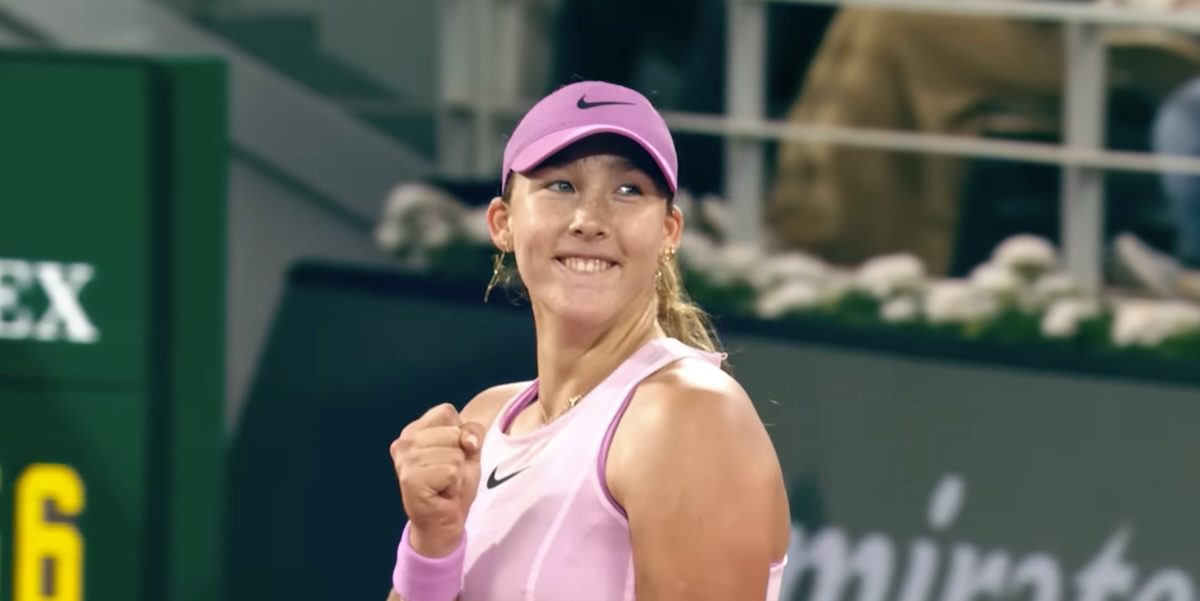
The Youngest Since Seles: How 19-Year-Old Mirra Andreeva Conquered Roland Garros
JD
Jonathan Davies French Open · 08 Jun 2026 · 8 min read
At 19 years and 38 days old, Mirra Andreeva walked off Court Philippe-Chatrier as the youngest Roland Garros women’s singles champion in over three decades. Her 6-3, 6-2 win over Polish qualifier Maja Chwalińska sealed a first Grand Slam title — and, by a margin of roughly three months, edged her past Iga Świątek‘s 2020 mark to make her the youngest champion in Paris since Monica Seles in 1992. The number that matters is the age, and the age is barely believable.
Andreeva had threatened this for two years. She reached the Roland Garros semi-final in 2024 at just 17, broke into the WTA top 10 in early 2025, and arrived in Paris this year as one of the most complete young players the women’s game has produced in a generation. The breakthrough, when it came, was emphatic rather than fortunate. Here is where she sits in the history books, how she got there, and what a maiden major at 19 sets up next.
The Youngest Since Seles
The headline is the age. Andreeva lifted the Suzanne-Lenglen trophy at 19 years, 38 days — younger than any Roland Garros women’s champion since the Monica Seles era. Seles won three straight titles in Paris from 1990, the last of them in 1992, every one of them at an age below Andreeva’s. The table below ranks the youngest champions of the Open era’s modern run, youngest to oldest.
The nuance worth dwelling on is the line directly below Andreeva. Iga Świątek’s 2020 title — the launchpad for a player who would go on to dominate the clay — came when the Pole was 19 years, 132 days old. Andreeva won at 19 years, 38 days. The gap is roughly three months, but it is the margin that makes the “youngest since Seles” claim hold: every champion in the 34 years between Seles and Andreeva was older on the day they won than Andreeva is now.
Why the Teenage Champions Disappeared
There is a structural reason the gap between Seles and Andreeva stretched across more than three decades. After the burnout cautionary tales of the late 1980s and early 1990s, the WTA introduced its Age Eligibility Rule in 1995, capping the number of professional tournaments players under 18 can enter and phasing them in gradually. The teenage prodigy who plays a full tour schedule and wins a major at 16 or 17 — the Seles or Sánchez Vicario model — was effectively legislated out of the game.
That makes Andreeva’s achievement rarer than the raw “youngest since 1992” line suggests. She has reached the summit not by being rushed onto a full schedule as a 15-year-old, but by climbing in the managed, modern way — and still arriving as a Grand Slam champion at 19. In the current era, that is about as young as it realistically gets.
From 17-Year-Old Semi-Finalist to Champion
None of this arrived out of nowhere. Andreeva announced herself at Roland Garros in 2024, reaching the semi-final at 17 — the kind of run that usually marks a player as a future contender rather than an immediate one. She did not wait long to convert the potential. In early 2025 she broke into the WTA top 10, becoming the youngest player to do so since Nicole Vaidisova managed it in 2007.
The trophy haul built quickly alongside the ranking. Andreeva has now won five WTA titles, two of them at WTA 1000 level — the tier directly below the Slams. That is a record most players assemble across their early-to-mid twenties, not before their twentieth birthday. The 2026 French Open is the capstone: a first major, and the moment the projection became reality.
The Final: A Fairy Tale Ended
The story on the other side of the net was almost as compelling. Maja Chwalińska arrived in the final as a qualifier ranked outside the top 100 — a player who had to win matches just to reach the main draw, then strung together a run that carried her all the way to a first Grand Slam final. It was the kind of fortnight that rewrites a career. Afterwards, Chwalińska rocketed roughly 93 places to a career-high World No. 21.
For a set, she made Andreeva work. The Russian trailed 2–3 in the opening set, the match still in the balance, before the gap in quality told. Andreeva reeled off a long run of games to take control, turning a tight scoreline into a decisive one. The final read 6-3, 6-2 — comfortable on paper, but it took a stretch of relentless, error-free tennis to make it so. The fairy tale ended the way the rankings suggested it might, but Chwalińska left Paris a top-25 player with the biggest payday and ranking jump of her life.
A Game Beyond Her Years
What separates Andreeva from the usual teenage prospect is not raw power — it is maturity. Hers is a remarkably complete, all-court game: clean groundstrokes off both wings, excellent movement, and a tactical intelligence that reads years ahead of her age. She constructs points rather than blasting through them, working an opponent out of position before she finishes, and that patience is exactly the trait that wins on the slow Parisian clay where rallies are long and shortcuts punished.
It is a style that ages well. Power-first teenagers can burn bright and fade; players who think their way around a court tend to last. Andreeva belongs firmly in the second group, which is why a first major at 19 reads less like a ceiling and more like a floor.
The Teenage Wave
Andreeva is not a lone outlier. She sits at the front of a genuine teenage wave reshaping the WTA. Victoria Mboko has surged up the rankings, and 18-year-old Iva Jovic is climbing fast behind her. After years in which the women’s game leaned on a small group of established stars, the depth at the top of the age curve is suddenly real — and Andreeva, as the first of the group to win a Slam, is its standard-bearer.
For a sport that constantly hunts for its next era, this is the answer arriving early. You can track where these names sit week to week on the WTA rankings, and the gap between projection and silverware is closing fast.
What Comes Next
The Roland Garros title lifted Andreeva to World No. 6 on 5,751 points, up two places and a career-high inside the top five. The question now is no longer whether she belongs at the top — it is how high she goes.
Marker
Detail
Grand Slam titles
1 (French Open 2026, aged 19)
Best major before 2026
French Open semi-final 2024 (aged 17)
WTA titles
5, including two WTA 1000s
Milestone
Youngest into the WTA top 10 since 2007
Current ranking
World No. 6
The grass swing is the immediate test. A clay-court breakthrough does not automatically translate to the quicker surface, and Wimbledon will demand a different rhythm — flatter, faster, less time to build the patient points that served her so well in Paris. But a player with this much movement and shot-making rarely struggles to adapt for long.
The longer game is World No. 1. At 19 with one major already banked, a career-high ranking, and a complete game still developing, Andreeva has the runway most players only dream of. Whether she gets there depends on consistency across surfaces and the depth of the field she is leading — but on the evidence of this fortnight, the ceiling is a long way up. You can follow how the chase unfolds across the season leaders as the year runs on.
FAQ
How old is Mirra Andreeva?
Mirra Andreeva was born on 29 April 2007, making her 19 years old. She won the 2026 French Open at 19 years and 38 days.
Is Mirra Andreeva the youngest French Open champion ever?
No. She is the youngest Roland Garros women’s singles champion since Monica Seles in 1992, but Seles herself won at 16, and both Arantxa Sánchez Vicario (1989) and Steffi Graf (1987) won younger than Andreeva. She is, however, narrowly younger than Iga Świątek was when Świątek won in 2020.
Who is the youngest Grand Slam winner?
At Roland Garros, the youngest women’s champion is Monica Seles, who won the title at 16. On the broader question of the youngest-ever Grand Slam champion across all four majors, that record is generally cited around the Martina Hingis / Monica Seles era — but the relevant point for Andreeva is that she is the youngest Roland Garros champion since Seles in 1992.
How many Grand Slams has Mirra Andreeva won?
One. The 2026 French Open is her first Grand Slam title, won at 19. Before that, her best major result was the Roland Garros semi-final in 2024 at age 17.
FAQ
Mirra Andreeva Record FAQs
How old was Mirra Andreeva when she won Roland-Garros?
19 years and 38 days, making her the youngest Roland-Garros women’s singles champion in over three decades.
Who was the youngest Roland-Garros champion before her?
Monica Seles, who won three straight titles in Paris from 1990. Andreeva is the youngest champion since that era.
How does she compare with Iga Świątek?
Świątek’s 2020 title, the launchpad for her clay-court dominance, came at 19 years and 132 days. Andreeva was younger.
Why was there such a long gap between Seles and Andreeva?
There is a structural reason. After the burnout cases of the late 1980s and early 1990s, the WTA introduced its Age Eligibility Rule, which limits how much professional tennis players under 18 can play.
#AD. 18+. New customers only. For New Customers. Min deposit requirement. Free Bets are paid as Bet Credits and are available for use upon settlement of qualifying bets. Min odds, bet and payment method exclusions apply. Returns exclude Bet Credits stake. Time limits and T&Cs apply.
#AD. 18+. New customers only. Place a min £10 bet on Sportsbook on odds of min EVS (2.0), get 5x £10 in Free Bet Builders, Accumulators or multiples to use on any sport. Rewards valid for 30 days. Only deposits via Pay by Bank, Apple Pay or Debit Card will qualify. T&Cs apply. Please Gamble Responsibly.
18+ · New customers only · Please gamble responsibly · BeGambleAware.org