Features
At 15 years old, Teo Davidov is officially the youngest ranked player on the ATP Tour. He is also the only one with no backhand. The teenage Bulgarian-American does not just hit two forehands by switching the racket between his hands — he also serves both left-handed and right-handed, a combination Andy Roddick has called “potentially game-changing”. A viral video out of the under-12 Easter Bowl was watched more than 320,000 times on Twitter; his Les Petits As 2024 highlights were among the most-shared tennis clips of the year. In February 2026 he reached the semi-finals of the ITF M15 Naples and earned his first ATP ranking points. The question now is no longer whether he is interesting. It is whether he is the future.
Teodor “Teo” Davidov was born in Sofia, Bulgaria on 26 August 2010 and now lives and trains in the United States. He competes on both the ITF Junior Circuit and the ITF Men’s World Tennis Tour and is currently sponsored by Babolat. His coach is his father, Kalin Davidov, who has worked with him since Teo first picked up a racket at four and a half.
His unique playing style was not the result of a grand experimental project. Kalin started Teo on a basic coordination drill aged eight, alternating which hand held the racket. The boy’s left-handed forehand turned out to be unusually strong, the drill became a regular feature of practice, and over time it stopped being a drill at all. By the time Davidov was competing seriously in junior tennis, he had no backhand. He had two forehands instead.
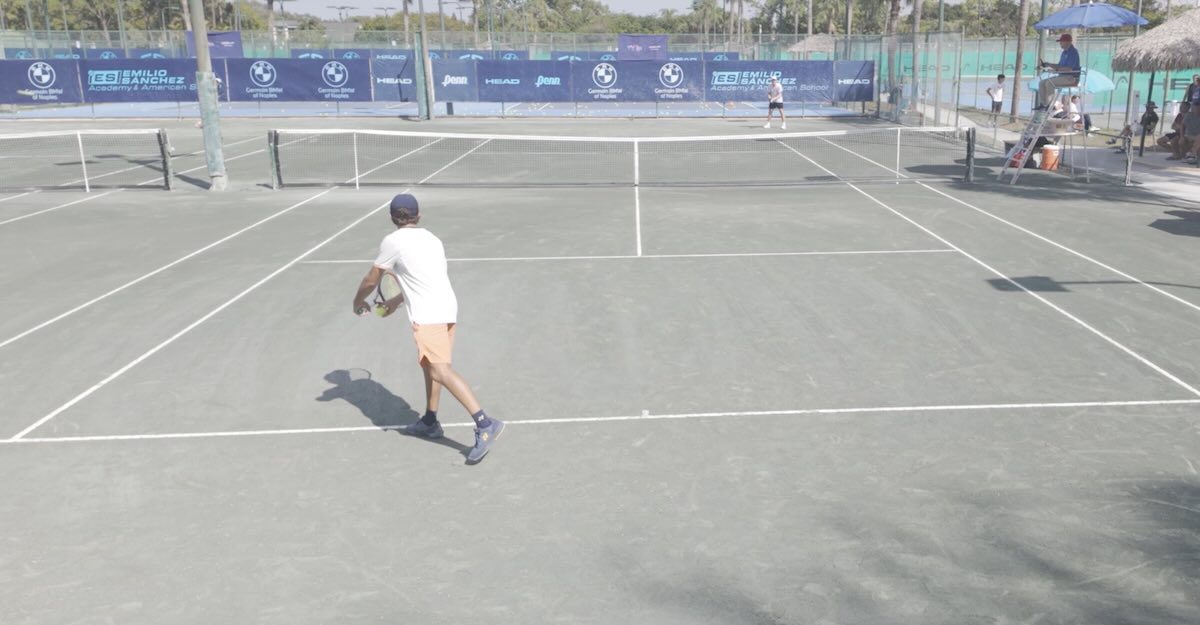
The headline is the racket switch. When the ball is hit to his right side, Davidov holds the racket in his right hand and hits a conventional right-handed forehand. When the ball is hit to his left, he transfers the racket to his left hand mid-stride and hits a left-handed forehand. The transfer happens almost imperceptibly between split-step and shoulder turn. To opponents, the effect is that he never has to hit a defensive shot off his weaker side because there is no weaker side.
The bigger innovation, almost lost in the noise, is the serve. Davidov serves with both hands. He has a left-handed first serve and a right-handed first serve, and chooses which to use based on the opponent and the scoreline. Andy Roddick discussed Davidov on his Served podcast and pointed straight at this:
“To have a guy who can effectively serve left-handed and right-handed at the same level… that is potentially game-changing. The serving aspect is what really interests me. It’s like having a baseball pitcher who can throw equally well from both sides.”
Roddick was more cautious about the groundstrokes. He questioned whether the racket-switch can hold up “when the speed ramps up at higher levels”, though he added that he hoped he would be wrong. The dual serve, by contrast, is the kind of structural advantage that does not go away no matter how fast the game gets.
Until early 2026, Davidov was a junior curiosity who happened to keep winning. That changed in February at the ITF M15 Naples in Florida.
| Tournament | Date | Result |
| Les Petits As (U14) | 2024 | Doubles champion at the most prestigious U14 event in the world |
| ITF M15 Naples, FL | Feb 2026 | Semi-finals from qualifying. First ATP ranking points |
| HotelPlanner Shootout, Delray Beach | Mar 2026 | Quarter-finals |
Davidov entered Naples as a 15-year-old wildcard and beat older, professional opponents to reach the semi-finals. He picked up his first ATP points in the process, and walked off the court as the youngest ranked player on the entire ATP Tour. A month later he reached the quarter-finals at the HotelPlanner Shootout in Delray Beach.
To put that in context, the youngest ATP-ranked players over the last two decades have almost all gone on to be top-100 players: Rafael Nadal earned his first ATP point at 15, as did Carlos Alcaraz. Davidov is not quite at their pace yet, but he is on a list with very, very few names.
Davidov has been a social media phenomenon for several years, but the volume has accelerated in 2026 as his on-court results have caught up with the highlight reel.
On the videos, the comments sections divide neatly. Coaches and tennis purists who have not seen him play are sceptical. Players and observers who have actually faced him or watched extended footage tend to be impressed. Davidov himself put it directly: “People who have never seen me play in real life often criticise my style of play.”
Davidov is not the first player to use a two-handed forehand at a serious level, but he is taking the concept further than anyone before him.
| Player | Era | Style | Achievements |
| Pancho Segura | 1940s-50s | Two-handed forehand, one-handed backhand | 3-time US Pro champion. Considered the original 2HFH innovator |
| Jimmy Connors | 1970s-80s | Two-handed backhand pioneer (one-handed forehand) | 8 Grand Slam titles. Made the 2HBH mainstream |
| Monica Seles | 1990s | Two-handed off both wings | 9 Grand Slam titles. The most successful “two and two” player in history |
| Fabrice Santoro | 1990s-2000s | Two-handed forehand and backhand | “The Magician”. 6 ATP titles. Known for tactical creativity |
| Marion Bartoli | 2000s-10s | Two-handed off both wings | 2013 Wimbledon champion |
| Peng Shuai | 2000s-10s | Two-handed off both wings | Top 15 WTA, US Open SF |
| Teodor Davidov | 2020s | Two forehands (no backhand) plus dual-handed serve | Youngest ranked player on the ATP Tour at 15 |
What sets Davidov apart is the combination. Bartoli and Seles still played a recognisable two-and-two game, with their non-dominant hand always on the racket. Davidov releases the racket entirely, hits two genuine one-handed forehands, and serves with whichever arm he chooses. Nobody at his level has done that before.
Tennis’s most fundamental tactical principle is “find the backhand”. From junior coaching upwards, every game plan begins with the assumption that an opponent has a stronger wing and a weaker wing. Cross-court drills, serve placements, approach-shot patterns, and entire gameplans are built around forcing errors on the backhand side.
Against Davidov, that pattern collapses. The opponent has to choose whether to hit to his right hand (a strong forehand), his left hand (also a strong forehand), or somewhere awkward in the middle as he is switching. Reports from his junior matches consistently note that opponents become hesitant with their shot selection — they no longer have a default “safe” pattern, and when they try to attack mid-court, Davidov’s spread of strike zones is wider than the standard player’s.
The flaws are real too. The racket switch costs a fraction of a second. At club and junior level he has more than enough time. At Tour level, where Sinner and Alcaraz can take the ball on the rise inside the baseline, that fraction of a second matters. The key question for Davidov’s career is whether he can compress the switch enough that the time penalty becomes negligible, the way Sinner compressed his service motion to add 8mph between 2024 and 2026.
Within professional coaching circles the debate splits along familiar lines.
The sceptical view: tennis at the elite level is increasingly about taking time away from opponents. The racket switch is, by definition, time you do not have. Roddick’s “speed test” argument falls into this camp. Several junior development coaches have privately said they would not recommend the technique to a young player as a development model.
The believer view: Davidov is, on the evidence, beating older opponents on actual scoreboards. The dual serve is independent of the groundstroke debate and offers a structural advantage at every level. And tennis history is littered with techniques that were dismissed as gimmicks until they became standard. Borg’s two-handed backhand was once the same kind of curiosity. So was Nadal’s heavy topspin. So, more recently, was Sabalenka’s serve mechanics. Tennis has a long track record of underestimating styles that look strange.
Almost certainly not as a wholesale model. Davidov’s father started the racket-switching as a coordination drill, not as a stylistic choice. The technique only emerged because Teo’s natural left-handed forehand was unusually strong and his hand-eye coordination unusually quick.
The dual-handed serve is a different conversation. Most ambidextrous people are functionally one-sided in tennis because they were taught that way. There is no technical reason a young player with even modest left-handed coordination could not develop a serviceable second-arm serve. If Davidov reaches the top 100 and the dual-serve continues to give him a tactical advantage in tiebreaks and big points, expect academies to start experimenting.
The realistic ladder for Davidov over the next 18 months looks like this:
| Stage | Target |
| 2026 | Continue ITF Futures campaigns to climb inside ATP top 700-800 |
| 2026-27 | Junior Grand Slams (US Open Juniors, Australian Open Juniors). Top junior ranking |
| 2027 | First ATP Challengers, first qualifying attempts at ATP 250 events |
| 2028+ | The real test — speed of higher-tier opponents will tell us whether the racket switch survives at Tour level |
The model is patient. Nobody serious is suggesting Davidov needs to be playing Grand Slams in 2027. The interesting timeline is the next three years, during which the technique either compresses to Tour-viable speed or hits a ceiling that will define the rest of his career.
Probably both. The dual-handed serve looks like a real, copyable innovation that could become a feature of the men’s game over the next decade. The dual-handed groundstroke pattern is harder to replicate — Davidov can do it because he was effectively raised ambidextrous from a coordination perspective, and the path is not open to most young players who have already grown into a dominant hand.
What is certain is that Davidov is genuinely the youngest ranked player on the men’s tour, that he is winning matches against fully-grown professional opponents, and that the standard tactical playbook does not work against him. Even if his groundstroke technique hits a ceiling, the serve alone makes him the most genuinely innovative player to enter the senior ranks in years. UK fans should remember the name. There will be a lot more to write.
Want to keep track of Davidov’s journey? We have built a dedicated player profile covering his background, ATP ranking, technique breakdown, and career results to date: Teo Davidov — Player Profile.