Features
Britain’s No. 1 male tennis player needed a wildcard to get into Wimbledon. The man who was ranked No. 4 in the world is now 147th, and sixth among his own countrymen. Both of those things are true this week.
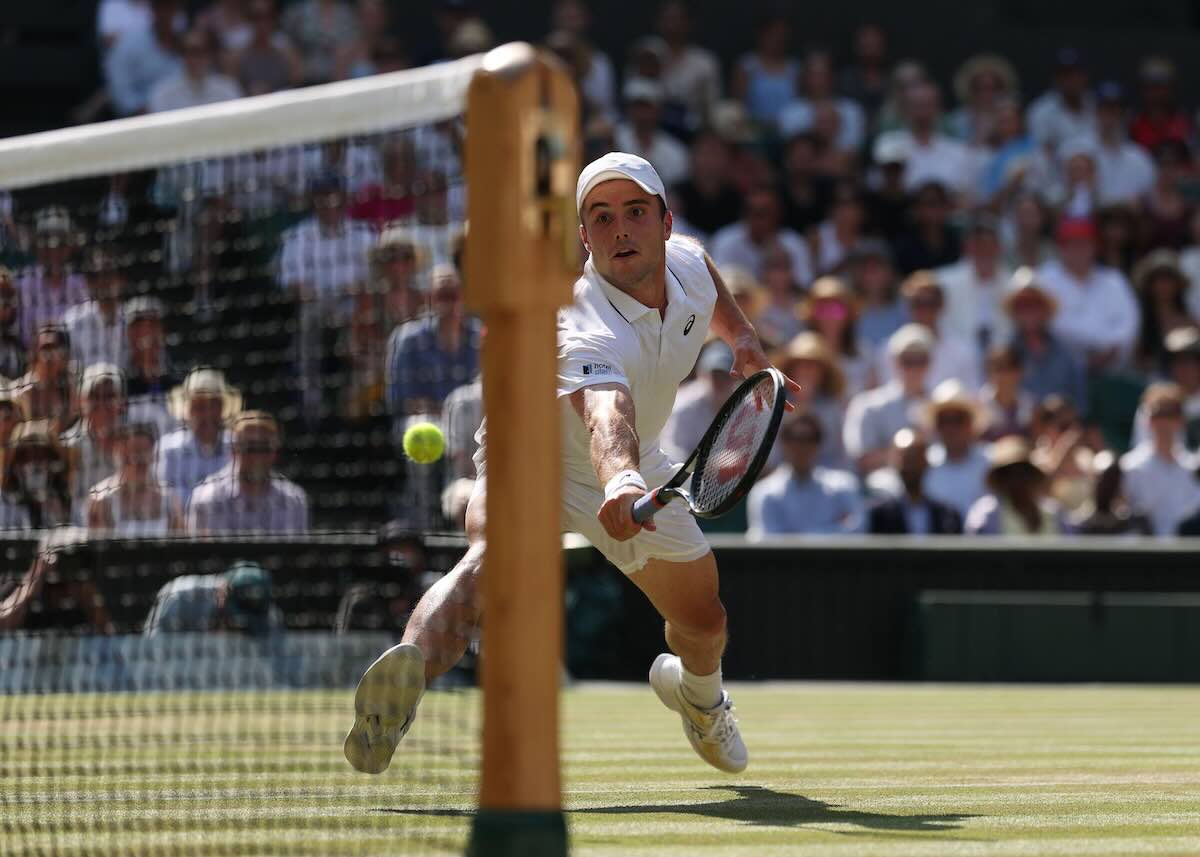
That first fact is not a criticism of Arthur Fery. It is the most remarkable thing in British tennis right now, and it took him ten days in July to make it true. He arrived at the All England Club on a wildcard with two Grand Slam main-draw wins to his name. He left it as the first British wildcard in 25 years to reach a Wimbledon semi-final, and as British No. 1 for the first time in his career.
The second fact is about Jack Draper, and it is the part that would have broken every previous version of British tennis. A year ago Draper was the story: a top-five player, a genuine Grand Slam contender, the answer to what happens after Andy Murray. He has played 17 tournaments this season. He is ranked 147.
Put those two sentences side by side and you have something British tennis has never managed before. The order at the top did not just change. It inverted, the country’s most experienced player retired in the same fortnight, and the whole thing held up anyway.
On the men’s side it is Arthur Fery, World No. 37. On the women’s side it is Emma Raducanu, World No. 49. Both are correct as of 27 July 2026, and you can follow the live picture on our ATP rankings and WTA rankings pages.
Fery took the men’s position off Cameron Norrie during Wimbledon, which is a sentence worth slowing down for. He beat 20th seed Alexei Popyrin. He beat Zizou Bergs in five sets, winning the fourth and fifth in tiebreaks. He beat Grigor Dimitrov. Then he beat ninth seed Flavio Cobolli in the quarter-final to reach the last four, where Alexander Zverev ended it.
That run made him the fifth British player in the Open era to reach the men’s singles semi-final at Wimbledon, and only the second wildcard of any nationality to do it since Goran Ivanišević in 2001. Ivanišević went on to win the tournament. Fery went to a career high of No. 36.
Raducanu’s position is quieter and, in some ways, more encouraging. She is 49 and climbing, up 12 places in the most recent update, which is her best standing since the injuries that followed her US Open title. She is still short of her own career high. She is also, at 23, younger than four of the six British women ranked below her.
To understand why the current picture matters, you have to be honest about the pattern it breaks. Britain has produced six Grand Slam singles champions in the whole history of the sport, and almost every one of them carried the country essentially alone.
| Player | Major titles | The record |
|---|---|---|
| Fred Perry | 8 | Career Grand Slam, three consecutive Wimbledon titles in the 1930s, last major in 1936 |
| Ann Jones | 3 | Wimbledon 1969, beating Billie Jean King in the final |
| Sue Barker | 1 | French Open 1976 |
| Virginia Wade | 3 | US Open 1968, Australian Open 1972, Wimbledon 1977 |
| Andy Murray | 3 | US Open 2012, Wimbledon 2013 and 2016, plus two Olympic singles golds |
| Emma Raducanu | 1 | US Open 2021, as a qualifier |
Perry won his last major in 1936. No British man won another for 76 years, until Murray beat Novak Djokovic at Flushing Meadows in 2012.
Seventy-six years is not a lean spell. It is four generations of players who were never going to win a major, and it happened because Perry was not the top of a system. He was the system. When he stopped, there was nothing underneath.
The women’s version of the same story is shorter but identical in shape. Wade won Wimbledon in 1977. The next British woman to win a Grand Slam singles title was Raducanu, 44 years later.
Between those poles sit the players British fans remember most vividly, and they are remembered for losing.
Tim Henman reached four Wimbledon semi-finals between 1998 and 2002. He lost every one of them to the eventual champion. That detail gets used as a punchline, but it is really a measure of how thin the margin was: Henman was good enough to be the last obstacle before the title four separate times, and Britain had nobody else near that level to share the weight.
Murray carried it further than anyone. He played seven Wimbledon semi-finals, more than any other British player in history, won three majors, and is the only man ever to win two Olympic singles golds. He also spent most of that time as the entire British men’s game. When his hip went, the country did not slow down gradually. It fell off a cliff, and there were stretches with no British man in the world’s top 100 at all.
On the women’s side, Johanna Konta reached the Wimbledon semi-final in 2017, losing to Venus Williams. That was her career best and, for a while, the high-water mark of British women’s tennis outside Raducanu’s fortnight in New York.
Six champions. One at a time. Every era ending in a hole, because there was never anything holding the floor up.
There are 26 British men inside the world’s top 500, and six inside the top 150.
Fery leads at 37, with Norrie at 39 immediately behind him. Those two are the only Britons in the world’s top 40, and Norrie has been the steadier presence for years without ever quite getting the attention Draper attracted.
Behind them is a group that did not exist eighteen months ago. Jan Choinski is 88 at the age of 30, a genuine late developer who has climbed while his contemporaries were retiring. Jacob Fearnley is 110. Toby Samuel is 112, which is worth reading twice: in June 2025 Samuel was ranked outside the world’s top 1000. He has moved roughly 1,700 places in a little over a year, winning three titles in three weeks in February and March, and reaching an ATP semi-final at Eastbourne where he beat the world No. 54.
Then Draper at 147, Billy Harris at 163, and Jack Pinnington Jones at 172.
Pinnington Jones is the clearest evidence that British men’s tennis now has a production line rather than a lottery. He spent three years at Texas Christian University and left a two-time singles All-American, the same route that produced Norrie and Fearnley before him. In February he beat world No. 20 Cobolli in straight sets at the Dallas Open. Three British players off one American college programme, all inside the world’s top 175, is not a coincidence.
There are 16 British women inside the top 500, and five inside the top 150. On current evidence the women’s game is the healthier of the two, and it is certainly the more interesting.
Raducanu at 49 and rising. Katie Boulter at 69, a long way below her career high of 23 but still Britain’s second-ranked woman. Francesca Jones at 110. Sonay Kartal at 122, having been as high as 44. Harriet Dart at 143.
The most instructive story in that group belongs to the player ranked below all of them. Katie Swan is 202 today. Two years ago she was not ranked at all.
A back injury cost Swan most of 2024 and dropped her out of the world rankings entirely, which is the point at which most careers quietly end. She won four ITF titles in 2025 to climb back to No. 275. In 2026 she won the Kurume International, then reached the second round at Wimbledon, her first win at the tournament since 2018, before losing to the 26th seed Madison Keys.
Below her, Alicia Dudeney is 225 at the age of 23. In a previous British era, a player like Swan disappearing for a year would have been a national problem. In this one it barely registered, because there were five women ranked above her and a queue forming behind.
And then there is the fortnight that actually gives this season its shape.
Dan Evans retired after Wimbledon, at 36, after a career of 20 years. He reached a career high of World No. 21. He won two ATP titles. He was part of the Great Britain side that won the 2015 Davis Cup, the country’s first in 79 years. And in 2021 he beat Djokovic 6-4, 7-5 at the Monte-Carlo Masters, the world No. 1’s first defeat of that entire season, having arrived in Monaco on a 10-match losing streak on clay.
“…got me a little extra fired up.”Dan Evans, on being kept waiting in the changing room before he beat the world No. 1
He did all of it at 5ft 9in, on slice and variety, in an era built for people a foot taller. There has not been a British player like him and there may not be another.
His final professional match was the Wimbledon men’s doubles first round. He played it alongside Henry Searle, who is 20 years old, ranked 217, and whom Evans had spent the season mentoring. They lost 6-2, 6-4 to the ninth seeds on Court 15. Andy Murray came to the locker room afterwards.
A 36-year-old playing his last match beside a 20-year-old he had been teaching is about as literal as a handover gets.
Evans was not the only departure. Jodie Burrage, once ranked in the mid-80s, is outside the top 500 after a fourth career operation and has spoken publicly about considering retirement. Heather Watson is 34 and ranked 475. Liam Broady is 32, Ryan Peniston is 30 and 445th. The generation that held British tennis together through the post-Murray years went, more or less, in one season.
Here is the whole argument in one comparison.
| When it happened | What Britain lost | What came next |
|---|---|---|
| 1936 | Fred Perry | 76 years without a British male major champion |
| 1977 | Virginia Wade | 44 years without a British female major champion |
| Late 2010s | Andy Murray’s hip | Stretches with no British man in the world’s top 100 |
| 2026 | Evans retires, Draper falls from No. 4 to 147, Burrage drops out of the top 500 | A wildcard reaches a Wimbledon semi-final; 11 Britons sit inside the world’s top 150 |
That bottom row is the story. This season British tennis absorbed the retirement of its most experienced player, the collapse of its highest-ranked prospect from fourth in the world to sixth in his own country, and the loss of a top-100 woman to injury. The response was a Wimbledon semi-finalist, a man who was outside the top 1000 fourteen months ago arriving at 112, and two players still inside the world’s top 40.
Twenty-one Britons are inside the world’s top 250. Eleven are inside the top 150. Those numbers are not spectacular by the standards of Spain or the United States, but by the standards of British tennis history they are unprecedented, and they do a specific job: they remove the cliff.
Depth has limits, and they matter. Eleven players in the top 150 will not win a Grand Slam. Britain’s two national No. 1s are ranked 37 and 49, and neither is currently a contender in New York. Depth is not a substitute for a champion, and anyone claiming British tennis is in a golden age is overreading it.
What depth does is change the consequence of failure. When Perry stopped, the sport in Britain stopped with him. When Draper fell 143 places, five compatriots were already above him and the country’s ranking picture barely moved. That is a structural difference, and it is new.
The part of this that should genuinely encourage anyone who follows British tennis is the age profile underneath.
There are three British teenagers inside the WTA top 400 at the same time, which has no real precedent.
| Player | Age | Junior credential |
|---|---|---|
| Mika Stojsavljevic | 17 | US Open girls’ singles champion at 15 |
| Hannah Klugman | 17 | French Open girls’ singles finalist, US Open girls’ semi-finalist |
| Henry Searle | 20 | Wimbledon boys’ singles champion |
Mika Stojsavljevic is ranked 280 and won the US Open girls’ title at 15, the first British winner of that championship in 15 years. Hannah Klugman is 374 and had one of the best junior seasons any British girl has produced, reaching the French Open girls’ final, the Wimbledon girls’ quarter-finals and the US Open girls’ semi-finals in the same year. Mimi Xu is 18 and ranked 332.
Searle, at 20 and 217, is further along, and his Wimbledon fortnight had a symmetry nobody planned: a Wimbledon boys’ champion playing the last match of a Davis Cup winner’s career, as his partner.
The honest caveat is that this is the stage where highly rated teenagers most often stall. The move from junior draws to senior weeks is a physical problem more than a technical one, and WTA age rules cap how many events an under-18 can play, so both Stojsavljevic’s and Klugman’s schedules are short by design. Expect a plateau before a breakthrough, and do not read a flat six months as a failure.
On the men’s side the equivalent group is slightly older and already ranked: Samuel and Pinnington Jones are both 23, Fearnley is 25, Fery is in his mid-twenties. That is a cohort entering its best years together rather than one player carrying a decade.
The US Open runs from 30 August to 13 September, and it is the best available test of whether any of this is real.
Fery goes in ranked 37, which means direct entry rather than a wildcard, and a seeding conversation if he holds his position. His hard-court record is the open question: the Wimbledon run was on grass, and New York asks different things of a player who won on variety and nerve.
Raducanu returns to the site of the title that changed her life, ranked 49 and in better form than at any point since. Norrie, Choinski, Fearnley and Samuel all have realistic main-draw places, and Swan will fancy qualifying after her Wimbledon fortnight.
Full coverage runs through our tournament hubs, and you can see what else is coming on the tennis calendar. Every British player mentioned here has a profile in our player index.