Features
The tennis GOAT argument is almost always settled with a single number: how many Grand Slams. It is the wrong number to stop at, because it leaves out the only evidence in which the candidates were tested directly against each other.
Novak Djokovic has 24 majors, Rafael Nadal 22, Roger Federer 20. That gap has been the whole debate for a decade, and in January it very nearly closed differently: Djokovic reached the 2026 Australian Open final chasing a 25th and lost it to Carlos Alcaraz.
But the three of them also played each other 150 times. That record exists, it is complete, and it says something the Slam count cannot.
| Player | Majors | Weeks at No. 1 | Tour titles |
|---|---|---|---|
| Novak Djokovic | 24 | 428 | 101 |
| Rafael Nadal | 22 | 209 | 92 |
| Roger Federer | 20 | 310 | 103 |
Read that table on its own and Djokovic wins on two of three, with Federer ahead only on titles by a margin of two. It looks settled.
The problem is that a Slam count measures a player against the field. It does not measure him against the other two men in the argument, and those three played each other constantly, usually in the last four of the biggest tournaments on the calendar.
This is the part most GOAT pieces skip, because assembling it means reconciling three separate career-long records. Here it is.
| Rivalry | Record | Meetings |
|---|---|---|
| Nadal vs Djokovic | Djokovic leads 31-29 | 60 |
| Federer vs Djokovic | Djokovic leads 27-23 | 50 |
| Federer vs Nadal | Nadal leads 24-16 | 40 |
Djokovic has a winning record against both of the other two. Nadal has a winning record against one. Federer has a winning record against neither.
That is the cleanest statement of the case, and it is why the head-to-head is usually left out by people arguing for Federer.
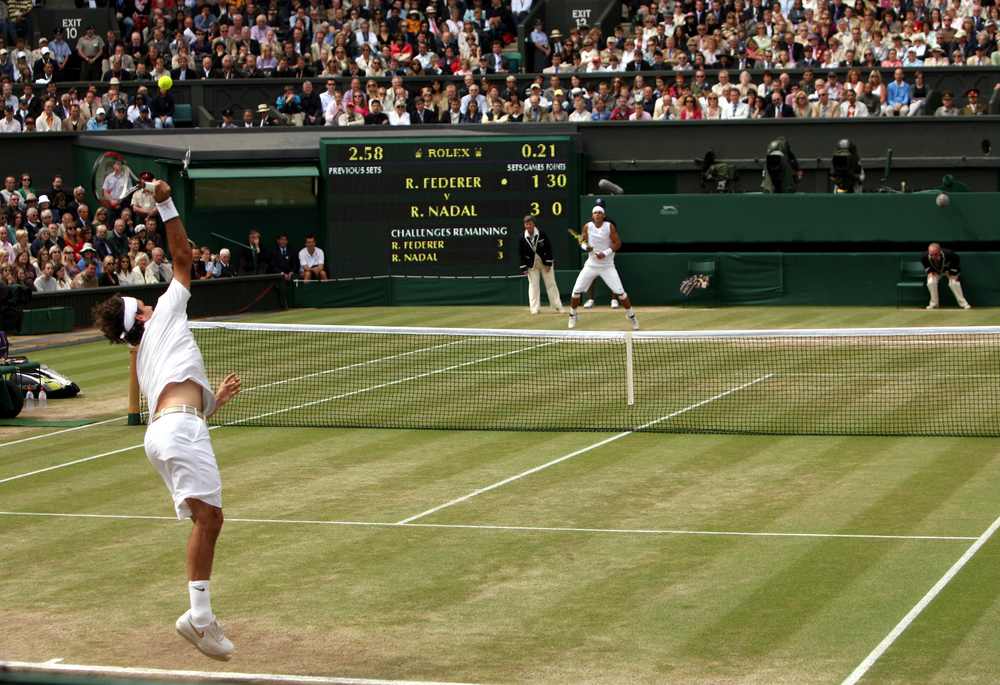
Nadal and Djokovic met 60 times, more than any pair in the history of men’s tennis, and finished a single match apart. Fifty matches between Djokovic and Federer produced eleven Grand Slam semi-finals, a record for any pairing. These are not small samples with noisy results. They are the largest bodies of direct evidence the sport has.
The 24-16 looks emphatic and it is also the most misleading number on this page. Look at where those 40 matches were played.
| Rivalry | Hard | Clay | Grass |
|---|---|---|---|
| Federer vs Nadal | 20 | 16 | 4 |
| Nadal vs Djokovic | 27 | 29 | 4 |
| Federer vs Djokovic | 38 | 8 | 4 |
Sixteen of the forty Federer–Nadal matches were on clay, the surface where Nadal won 14 French Opens and lost almost nothing. Only eight of the fifty Federer–Djokovic matches were. Federer’s record against Nadal is not evidence that Nadal was the better player so much as evidence of how the draw kept sending them to Roland-Garros.
The pattern within those clay matches is specific. Nadal is a left-hander who generated more topspin off the forehand than anyone before him, and he hit it cross-court into Federer’s one-handed backhand, where the ball climbed out of a comfortable strike zone. Djokovic had a double-hander that could absorb the same ball and send it back flat. One rivalry had an exploitable structural weakness in it and the other did not.
Djokovic is younger than Federer by almost six years. A meaningful share of their 50 meetings came when one man was at his peak and the other was past it, and the direction of that advantage reverses over the course of the rivalry. The same applies, less severely, to Nadal.
The second is that head-to-head rewards longevity in a way the Slam count does not. Djokovic outlasted both. He was still contesting a major final in 2026, at 39, and by then Federer had been retired four years and Nadal two.
Every measure in this argument is a measure of something slightly different. That is why it has never been settled, and why anyone claiming it is obvious is selling something.
It is less contested for a reason. Serena Williams won 23 Grand Slam singles titles, the most of anyone in the Open era, and spent 319 weeks at world No. 1 including a 186-week run that equalled Steffi Graf. She also won 14 Grand Slam doubles titles with her sister Venus, and the pair never lost a major doubles final.
Their own rivalry is the largest between two players who genuinely contended for the same era’s titles: 31 meetings, Serena ahead 19-12, including nine Grand Slam finals. And it is not closed. Both returned to the tour in 2026, and they played the Wimbledon doubles together more than two decades after the first of those 14 titles.
Any all-time argument that starts in 2003 is missing most of the sport. Björn Borg won 11 majors and then retired at 26, in January 1983, with six French Opens and five consecutive Wimbledons behind him. He never played the Australian Open in the years he was dominant, because most of the top players did not bother making the trip.
That is the honest problem with cross-era comparison. Borg’s 11 came from contesting roughly three majors a year rather than four. His rivalry with John McEnroe ran to only 14 matches and finished level at 7-7, which is a smaller sample than any Big Three pairing produced in a third of the time.
On the three measures that can actually be counted, the answer is Djokovic. He has the most majors, the most weeks at No. 1 by a distance, and a winning head-to-head against both of his rivals. No other candidate leads on all three.
The case against is not really a case about numbers. It is that Federer’s peak was higher than his record shows, that Nadal’s clay dominance is the single most extreme achievement in the sport, and that neither is fully captured by a career total. Both of those are reasonable, and neither is measurable.
What has changed is that the head-to-head evidence is no longer something you have to take on trust.
The Grand Slam counts, the three head-to-head records, and where to find the full data.
We have built out complete profiles and head-to-head pages for the players this argument is about, so the numbers above are all checkable rather than asserted.
Legends profiles: Djokovic · Nadal · Federer · Serena Williams · Venus Williams · Borg · McEnroe · Murray
Legends rivalries: Nadal vs Djokovic · Federer vs Nadal · Federer vs Djokovic · Borg vs McEnroe · Serena vs Venus
The full set sits in the Legends section of our player index and the head-to-head index, alongside every current player on tour.