Features
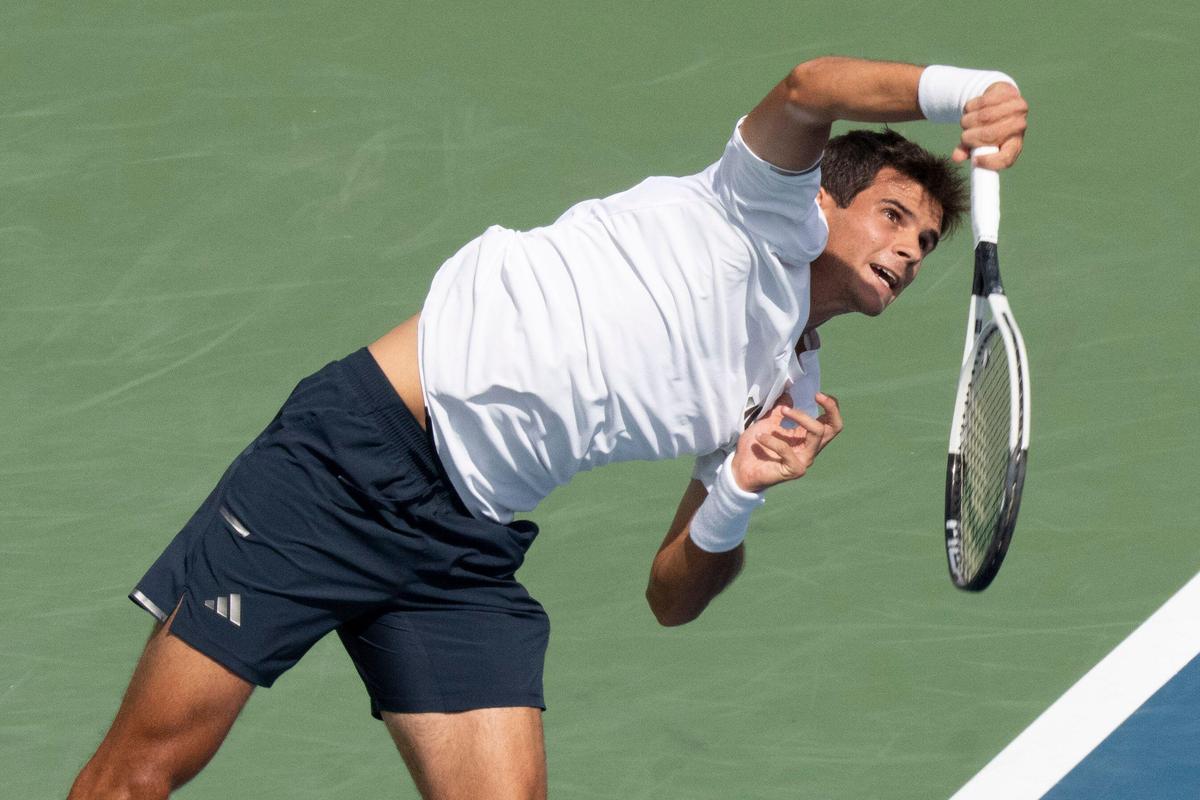
Twelve months ago Rafael Jódar was a second-year student at the University of Virginia, ranked outside the top 160 and still playing college tennis. Next week he walks out at the ATP Finals in Turin as the youngest of the eight men in the field. This is how a 20-year-old from Madrid, coached by his father, covered that distance in a single season.
Jódar took the eighth and last place at the ATP Finals on 6 November without hitting a ball, when Carlos Alcaraz beat Taylor Fritz in the Paris quarter-finals. He finished ninth in the Race to Turin on 3,234 points, and with Jannik Sinner out injured, ninth was enough. It was the last line of a year that had already included a first ATP title, a first Grand Slam quarter-final, a Masters 1000 final and a place in the top 10.
The starting point matters, because it is what makes 2026 unusual. Jódar arrived on the circuit through the American college system rather than the Spanish academy route that produced Alcaraz. After winning the US Open boys’ title in 2024, he joined the University of Virginia, where he won 15 of his first 16 matches in the spring of 2025 while picking up results on the Challenger tour alongside his studies.
He had already seen the Next Gen ATP Finals from the inside, as a hitting partner at the 2024 event. In December 2025 he went back as a player. In Jeddah he saved four match points to beat the top seed Learner Tien and also beat Martín Landaluce, but a 2-1 record in his group was not enough for the semi-finals. Tien went on to win the title, beating Alexander Blockx in the final.
On 31 December 2025, a few hours before the new season, Jódar announced that he was leaving college tennis to turn professional. He was ranked 168th.
The other thing that sets him apart is the team. There is no academy and no federation structure behind him. His coach is his father, also called Rafael, who taught himself the game in order to coach his son. During his run at the Madrid Open in the spring, Jódar put it simply: “The team has always been my father and me.” For now, he said, they had no plans to change something that was working.
That set-up looks even more striking this month, with the rest of the men’s tour reshuffling its coaching teams for 2027. Jódar has reached the top 10 without changing anything.
The breakthrough came quickly. In April Jódar won his first ATP title at the Grand Prix Hassan II in Marrakech, an ATP 250 on clay, beating Marco Trungelliti in the final. At the Barcelona Open, playing on a wildcard, he beat Jaume Munar 6-1, 6-2, received a walkover when Alcaraz withdrew with a wrist injury, and reached the semi-finals before losing 3-6, 6-3, 6-2 to the eventual champion Arthur Fils.
Madrid was where the wider public noticed him. Again on a wildcard, in front of a home crowd, he beat the fifth seed Alex de Minaur 6-3, 6-1 for his first top-10 win, then beat João Fonseca, and became only the third Spaniard after Rafael Nadal and Alcaraz to win a main-draw match at the Madrid Open before turning 20. Sinner, the world No. 1, ended the run 6-2, 7-6(0) in the quarter-finals, and we told the story of that fortnight in The Qualifier and the Wildcard.
He followed it with a quarter-final in Rome, where Luciano Darderi beat him 7-6, 5-7, 6-0, and then a first Grand Slam quarter-final at Roland Garros, which he played as a seed. Alexander Zverev beat him 7-6(3), 6-1, 6-3 on Court Philippe-Chatrier, but Jódar left Paris inside the top 30 with a clay season most established players would take.
On grass he showed a different quality. At Wimbledon he came from two sets to one down to beat Pablo Carreño Busta 3-6, 6-3, 1-6, 6-3, 6-4. On the American hard courts in the summer he went further. At the DC Open in Washington he beat Alejandro Tabilo 6-7(6), 6-4, 6-4 to reach his first ATP 500 final, which he lost 7-6(2), 6-4 to Fritz after rain pushed it back to the Monday. The run took him to a career-high No. 15.
Days later, at the National Bank Open in Montreal, he beat two seeds and then Fils 7-6(5), 6-3 to reach his first Masters 1000 semi-final, where Brandon Nakashima beat him 7-6(3), 6-4.
The low point followed. Seeded 12th at the US Open, Jódar lost in the first round to the lucky loser Yunchaokete Bu, 6-2, 6-1, 6-1. He then played the Laver Cup for Team Europe and lost his first match in Tokyo to the qualifier Adolfo Daniel Vallejo. For a few weeks his season looked as if it had peaked in August.
The Shanghai Masters changed that. As the No. 12 seed, Jódar lost the first set in each of his first four matches, against Thiago Agustín Tirante, Jiří Lehečka, Botic van de Zandschulp and Casper Ruud, and won all four. In the semi-finals he beat Daniil Medvedev 6-3, 6-4, his second top-10 win of the season.
He took the first set of the final 6-1 against Alejandro Davidovich Fokina and led by a break in the second. Davidovich Fokina came back to win 1-6, 7-6(5), 6-4 after two hours and 28 minutes, as our report of the final describes. The 650 points from that run are why he finished the season in a qualifying place. He left China ninth in the Race and at a joint career-high No. 11 in the rankings.
The last three weeks were nervous ones. In Basel, as the No. 3 seed, he lost to the eventual champion Valentin Vacherot in a deciding-set tie-break, but his results through the autumn still lifted him into the top 10 for the first time on 2 November. At the Paris Masters he beat Tabilo and then lost 6-3, 6-4 to Ruud on 3 November, which left his place in Turin in other players’ hands.
De Minaur finished 64 points behind him. Fritz needed to reach the semi-finals in Paris to pass him, and on Friday 6 November held two match points against Alcaraz in the quarter-finals before losing 6-7(10), 7-5, 6-3. The same evening Ben Shelton beat Tommy Paul, and the field was complete: Frances Tiafoe and Jódar took the last two places.
| Measure | 2026 |
|---|---|
| Ranking when he turned pro (31 December 2025) | No. 168 |
| Career-high ranking | No. 10 (2 November 2026) |
| ATP titles | 1 (Marrakech, clay) |
| Other finals | Washington (ATP 500), Shanghai (Masters 1000) |
| Best Grand Slam result | Quarter-final, Roland Garros |
| Grand Slam record | 7-4 |
| Masters 1000 record | 20-7 |
| Wins over top-10 players | 2 (de Minaur in Madrid, Medvedev in Shanghai) |
| Race to Turin | 9th, 3,234 points |
The Grand Slam and Masters 1000 records are the ATP’s figures. His live position is on our ATP rankings page.
The comparison with Alcaraz is the obvious one, and the ATP has drawn it. Jódar is only the fifth player to qualify for the ATP Finals the year after qualifying for the Next Gen ATP Finals, after Zverev (2017 and 2018), Stefanos Tsitsipas (2018 and 2019), Alcaraz (2021 and 2022) and Holger Rune (2022 and 2023).
Look closer and the list gets shorter. Zverev did not play the 2017 Next Gen event because he had already qualified for the main one, Rune withdrew from the Next Gen event in 2022, and Alcaraz, who won the Next Gen title in 2021, was injured and missed Turin in 2022. Only Tsitsipas played both events in consecutive years. If Jódar takes the court in Turin, he will be the second.
The ranking jump has very few parallels either. According to Tennis Majors, no player has qualified for the season finale after starting the year ranked as low as Jódar did. The previous lowest was Mariano Puerta, who started 2005 at No. 133.
Jódar is 1.91m tall and right-handed with a two-handed backhand, and his serve is a weapon, but the numbers point to his return. On our return leaderboard, updated after the US Open, he was fourth on the ATP Tour with a return rating of 158.6, behind only Alcaraz, Daniel Mérida and Sinner. He is also among the best in tight finishes: our under-pressure table has him winning 76.5% of his deciding sets.
Shanghai showed both. Coming from a set down four times in a row takes a returner who can turn a match round and a player who stays composed when he is behind. The final against Davidovich Fokina showed the other side: the one time this season he had a Masters title within reach, he could not close it out.
The ATP Finals run from 15 to 22 November at the Inalpi Arena, and the round-robin groups are drawn on Thursday 12 November. Whoever he draws, Jódar will be the outsider. Zverev, Alcaraz, Shelton, Medvedev, Cobolli, Fils and Tiafoe make up the rest of the field, and He has beaten Medvedev and Fils this year and lost to Zverev at Roland Garros. But he goes in with nothing to lose, as one of two Spaniards in the field alongside Alcaraz, and with a 20-7 record at Masters 1000 level that shows how well he plays on the biggest stages.
Whatever happens in Turin, the season is already a success. A year ago he was choosing between a degree and a career. Now he is in the top 10. Our Rafael Jódar profile has his results and ranking history, and the ATP Finals 2026 hub will have the groups, the schedule and every result.
Rafael Jódar was born in Madrid on 17 September 2006. He turned 20 in September 2026 and is the youngest player at the 2026 ATP Finals.
Jódar is 1.91m (6ft 3in) tall. He is right-handed and plays a two-handed backhand.
His father, also called Rafael Jódar, who taught himself the game in order to coach his son. Jódar has said the team has always been the two of them.
Yes. He played for the University of Virginia after winning the US Open boys’ title in 2024, and left college tennis to turn professional on 31 December 2025, when he was ranked 168th.
World No. 10, which he reached for the first time on 2 November 2026. His current position is on our ATP rankings page.
Yes, one. He won the Grand Prix Hassan II in Marrakech in April 2026. He has also reached finals in Washington and at the Shanghai Masters, where he lost to Alejandro Davidovich Fokina.
For more long reads see our tennis features, including the story of Jódar and Alexander Blockx at the Madrid Open. The ATP Finals field and points are on the Race to Turin page.